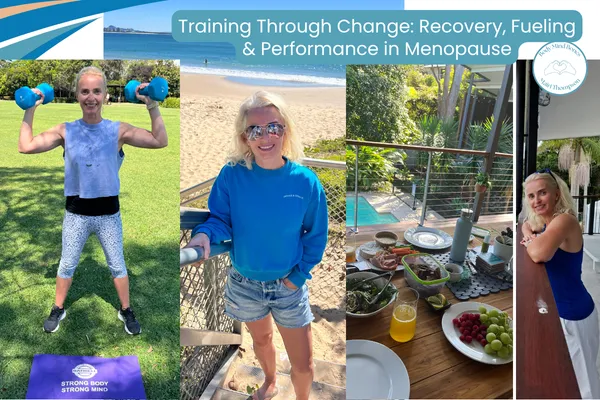
Training Through Change: Recovery, Fueling & Performance in Menopause
For many women, midlife becomes a turning point in how their body responds to exercise, recovery, and nutrition. What once worked may suddenly feel less effective - or even counterproductive.
Fatigue creeps in faster. Muscle soreness lasts longer. Body composition feels harder to shift. And despite increasing effort in training, results don’t always match the input.
This isn’t a motivation problem. It’s a physiological shift that deserves a different approach.
When More Training Stops Working
A common pattern seen in midlife women is a push to “train harder” in response to changes in body composition, energy levels, or performance.
But this often overlaps with three key issues:
Inadequate protein intake
Overall low energy (calorie) intake
Overtraining without sufficient recovery support
Individually, these can be manageable. Together, they create a cycle that the body struggles to recover from.
Instead of progress, we see:
Persistent fatigue
Muscle soreness that lingers
Plateaus in strength or performance
Increased injury risk
Frustration around body composition changes
The body isn’t resisting change - it’s asking for support.
Recovery Is Not Optional - It’s Physiological Training
Recovery is often treated as what happens when training stops. But in reality, recovery is part of the training process itself.
During recovery, the body:
Repairs muscle tissue
Regulates inflammation
Supports joint and connective tissue health
Integrates training adaptations
Restores nervous system balance
Improves sleep quality and resilience
Without this phase, training becomes incomplete - like repeatedly stressing the system without allowing adaptation to occur.
This is why mobility work, structured recovery sessions, and sleep quality matter just as much as the workout itself, especially in menopause when recovery capacity naturally shifts.
Why Menopause Changes the Conversation
Hormonal changes during menopause influence how the body responds to stress, fuel, and exercise.
This can affect:
Energy availability
Muscle protein synthesis
Recovery speed
Thermoregulation
Stress tolerance
This doesn’t mean women should train less. It means training inputs and recovery strategies need to be better matched to the body’s current state.
It also explains why approaches that once “worked fine” may suddenly feel ineffective.
Fueling Matters More Than Ever
One of the most overlooked factors in midlife training is under-fuelling.
Many women unintentionally reduce food intake while simultaneously increasing training demands, often in pursuit of fat loss or improved body composition.
But chronically low energy availability can lead to:
Reduced training adaptation
Hormonal disruption
Poor recovery
Increased fatigue
Loss of lean muscle mass over time
Protein intake becomes especially important, as it supports:
Muscle repair
Strength maintenance
Recovery between sessions
Metabolic health
The goal isn’t eating more randomly - it’s eating enough to support the training being done.
High-Intensity Training Like HYROX: A Different Demand
Events like HYROX, marathons, and endurance-style training place a significant demand on the body.
In midlife, the same training load may require:
More structured recovery periods
More deliberate fueling strategies
Greater attention to fatigue signals
Smarter programming around intensity balance
It’s not that these goals are off-limits, but the path to achieving them may need to be adjusted.
Ignoring recovery or under-fuelling while training at this level often leads to burnout rather than performance gains.
When Fat Loss Isn’t Responding the Way It Used To
Another common frustration is changes in body composition that don’t respond to previous strategies.
In menopause, this can be influenced by:
Hormonal shifts affecting fat distribution
Reduced recovery capacity
Increased stress load
Lower muscle mass maintenance if protein and training aren’t aligned
This is where the conversation needs to shift away from “more restriction, more cardio, more effort”, and toward:
Better recovery
Adequate protein intake
Strength-focused training
Sustainable energy availability
The Bigger Picture: Adaptation Over Exhaustion
Across all of these themes - training, recovery, fueling, and performance - one principle stands out:
The goal is not to push harder indefinitely. The goal is to adapt better.
When the body is supported, it becomes more resilient. When it’s under-fuelled and under-recovered, it becomes more reactive.
Progress in midlife isn’t about doing less. It’s about doing things differently.
Menopause doesn’t reduce your capacity for strength, performance, or transformation - but it does change the conditions required to achieve them.
When recovery, fueling, and training are aligned, the body responds. When they’re not, it compensates, often in ways that feel like stagnation or setback.
The shift is not about restriction or limitation.
It’s about strategy.