What Got You Here, Won’t Get You There: My Bone Health Wake-Up Call
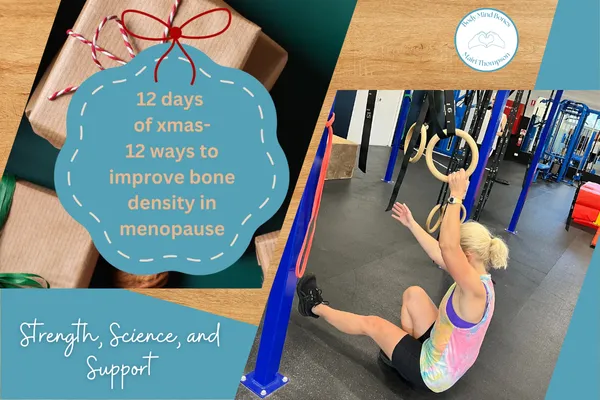
As we move through the 12 Days of Christmas: Bone Density Edition, I wanted to pause and share the personal story behind why bone health - and women’s health in midlife - matters so deeply to me.
This isn’t just a professional interest. It’s personal.
My Diagnosis: The Moment Everything Shifted
Two years ago, I received a diagnosis that stopped me in my tracks:
Osteopenia.
I’ve spent years training women through perimenopause and menopause. I’ve studied the research. I’ve lived the lifestyle. Yet hearing those words firsthand changed the way I approached my own health, and the way I approach my work.
Recently, I had a repeat DEXA scan.
Despite consistent training, thoughtful nutrition, and the “right” habits…
My bone density had decreased even further.
I won’t sugarcoat it: it was devastating.
I’ve lifted heavy. I’ve added plyometrics. I’ve optimized protein. I’ve done the work, yet the numbers still moved in the wrong direction.
That’s when a hard truth hit me:
“What Got You Here, Won’t Get You There.”
When you layer perimenopause, thyroid dysfunction, and Hashimoto’s, the landscape changes.
What worked before isn’t always enough anymore.
I realized I needed to widen the lens and bring in additional evidence-based strategies, especially because bone health isn’t just about avoiding fractures. It’s about longevity, independence, strength, and quality of life.
The Changes I’m Making Now
Here’s what I’ve decided to shift in my own health plan - based on research, medical guidance, and a deep understanding of the hormonal and autoimmune factors at play.
1. Starting MHT (Menopausal Hormone Therapy)
The evidence for estrogen’s role in preserving bone density is incredibly strong.
For my personal health profile, continuing without it was no longer the best strategy.
2. Adopting a Zero-Tolerance Gluten Approach
With Hashimoto’s, gluten can fuel inflammation, affect gut health, and interfere with nutrient absorption - all factors that influence bone health.
For me, this change is non-negotiable moving forward.
3. Adding Targeted Supplements
Even with a balanced diet, thyroid medication can impact calcium absorption.
To support bone metabolism, I’m now supplementing with:
Calcium
Vitamin D
Vitamin K
Magnesium
This helps bridge the nutritional gaps created by thyroid interactions and fluctuating hormones.
4. Staying Consistent with Strength and Plyometrics
Impact and resistance training do work for bone health.
The 12 Days of Christmas–style exercises remain a core part of my routine.
But I now understand that exercise alone isn’t enough in the context of autoimmune conditions and hormonal shifts.
I’m keeping what works, while widening the toolkit.
Why This Matters for My Work
This experience has reshaped not just my personal health plan, but also the lens through which I coach and educate.
I’m not teaching from theory.
I’m teaching from:
Lived experience
Research-backed evidence
A deep personal investment in supporting women through midlife transitions
An understanding of the complexity of hormones, autoimmune conditions, and bone health
Every strategy I share is something I’ve questioned, tested, learned from, or implemented myself.
If You’re Navigating Menopause, Thyroid Issues, or Hashimoto’s…
You’re not alone, truly.
These conditions can make bone health more challenging, but not impossible.
If you feel confused, overwhelmed, or unsure where to start, I’m here.
Feel free to reach out, comment, or connect with me.
Sometimes all you need is someone who understands the nuances, and the emotions behind this journey.
Your health deserves a plan that evolves with you.
And it’s never too late to start taking stronger steps forward.