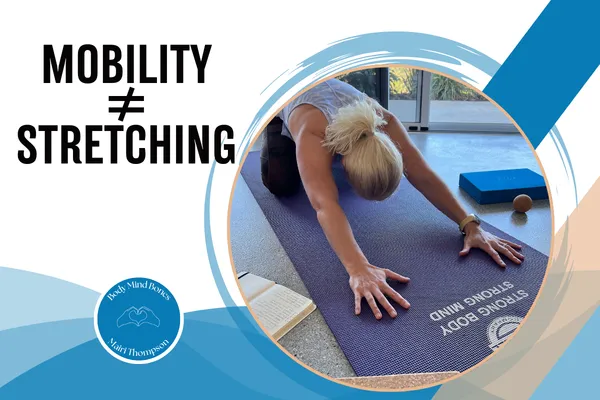
Menopause and Joint Mobility: Why Stretching Isn't Always Enough
Have you ever felt stiff through your shoulders or wrists, even when you stretch regularly?
You're not alone. Many women notice changes in how their joints feel and move during perimenopause and menopause. Reaching overhead, moving the shoulders backwards, or putting weight through the wrists may feel less comfortable than it used to.
While stretching can be useful, mobility work is another important piece of the movement puzzle.
At Body Mind Bones, I encourage women to look beyond stretching alone and consider how they can move their joints through their available range of motion with control, confidence and appropriate resistance.
Let's explore what mobility means, why it's worth including in your exercise routine during menopause, and two exercises you can try.
What is the difference between mobility and stretching?
Stretching generally focuses on lengthening muscles and other soft tissues to help improve flexibility.
Mobility, on the other hand, involves moving a joint through its available range of motion with control. Depending on the exercise, it may also involve a small amount of resistance.
Think of the difference this way:
Flexibility is about how much range of motion is available.
Mobility is about how well you can actively and comfortably move through that range.
Both can have a place in your exercise routine. However, mobility work can help you practice controlling movement rather than simply holding a stretch.
For example, being able to reach your arms overhead is one thing. Being able to move your arms overhead and back again with control is another.
Why does joint mobility matter during menopause?
During perimenopause and menopause, changes in estrogen levels can influence several tissues and systems throughout the body. Some women notice changes in joint comfort, stiffness or how easily they move.
Estrogen is involved in processes affecting connective tissues, and research continues to explore how hormonal changes may influence musculoskeletal health. However, joint stiffness is not experienced by every woman, and it can have many contributing factors.
This is one reason I encourage a well-rounded approach to movement during the menopause years, incorporating strength training, mobility, balance, recovery and appropriate cardiovascular exercise.
Mobility work may help you practice moving with control, maintain functional movement and prepare for the demands of your strength-training session.
The goal isn't to force your joints further. It's to help you move well within your current range.
Two shoulder mobility exercises to try
In my video, I demonstrate two exercises that focus on shoulder mobility, with the added benefit of incorporating wrist movement in the second exercise.
These may be useful additions to your warm-up, depending on your individual needs and abilities.
1. The shoulder pull-through
This exercise takes your arms through an overhead range of movement while you maintain gentle resistance.
How to do it:
Hold a suitable resistance band or exercise implement with both hands, using a grip that allows you to move comfortably.
Begin with your arms positioned in front of you, following the setup demonstrated in the video.
Slowly guide your arms up and overhead, moving through your available range.
Maintain gentle resistance and control as you bring your arms back through the movement.
Repeat for several controlled repetitions.
What to focus on: This isn't a competition to see how far your arms can travel. Focus on controlling the movement in both directions and keeping the resistance appropriate for your ability.
If your shoulders feel uncomfortable or you cannot complete the movement without forcing it, adjust your grip, reduce the range or choose a more suitable alternative.
2. The bodyweight shoulder extension exercise
The second exercise focuses on shoulder extension - moving the arms backwards relative to the body. This is a direction of movement that can be overlooked in everyday life.
The exercise also incorporates wrist movement, making it an opportunity to explore how these areas respond to a controlled bodyweight movement.
How to do it:
Begin in the position demonstrated in the video, with your hands supporting you behind your body.
Keep your feet close enough to your hips that you can move comfortably.
Gently lift your hips and move them towards your heels, allowing your shoulders and arms to move into extension.
Return to your starting position with control.
Repeat four or five times, staying within a comfortable range.
How to adapt it: Keeping your feet closer to your body can make the movement easier to manage. Moving your feet further away increases the challenge and may increase the stretch across the front of your shoulders and arms.
Only progress as far as you can comfortably control the movement. Pay attention to how your wrists feel, and don't force your shoulders into a deeper position.
If you have wrist or shoulder pain, an existing injury or difficulty supporting your bodyweight through your hands, seek guidance from an appropriate health professional or qualified exercise professional before trying this variation.
When should you include mobility exercises?
For many people, mobility exercises can be incorporated into a warm-up before strength training.
The movements you choose should relate to the session ahead. If you're planning to work your upper body, for example, controlled shoulder movements may be helpful preparation.
A few reminders:
Start with a range of motion that feels comfortable.
Move slowly enough to maintain control.
Use resistance that suits your current ability.
Avoid pushing into pain or forcing a joint into a position.
Adapt exercises to your mobility, strength and individual circumstances.
You don't need a long or complicated routine to begin exploring mobility. Consistency and appropriate exercise selection matter more than trying to achieve the biggest possible range of movement.
If stiffness is persistent, worsening or accompanied by swelling or significant pain, speak with a healthcare professional to help identify the cause.
Mobility is one part of the menopause movement puzzle
During menopause, it's easy to focus on one aspect of exercise - whether that's stretching, strength training or cardio.
But our bodies benefit from a more complete approach.
Alongside mobility work, strength training plays an important role in maintaining muscle and supporting bone health. Balance, cardiovascular exercise, recovery and adequate nutrition also contribute to overall health as we age.
The right combination will depend on your individual needs, health history and goals.
My aim at Body Mind Bones is to help women understand their changing bodies and feel more confident choosing movement that supports them through perimenopause, menopause and beyond.
Want more support with movement during menopause?
You don't have to navigate the menopause years alone. Having access to relevant education, practical movement guidance and a supportive community can help you feel more informed and confident about your health.
Join the Menopause Health Hub to connect with menopause-focused resources and support to help you on your journey.
Whether you're looking to learn more about movement, strength, mobility or bone health, the Hub is a place to continue building your knowledge and exploring ways to support your wellbeing through menopause.
👉 Join the Menopause Health Hub
I look forward to welcoming you!
Yours In Health,
Mairi
This article is for general educational purposes and is not a substitute for individual medical advice or assessment.