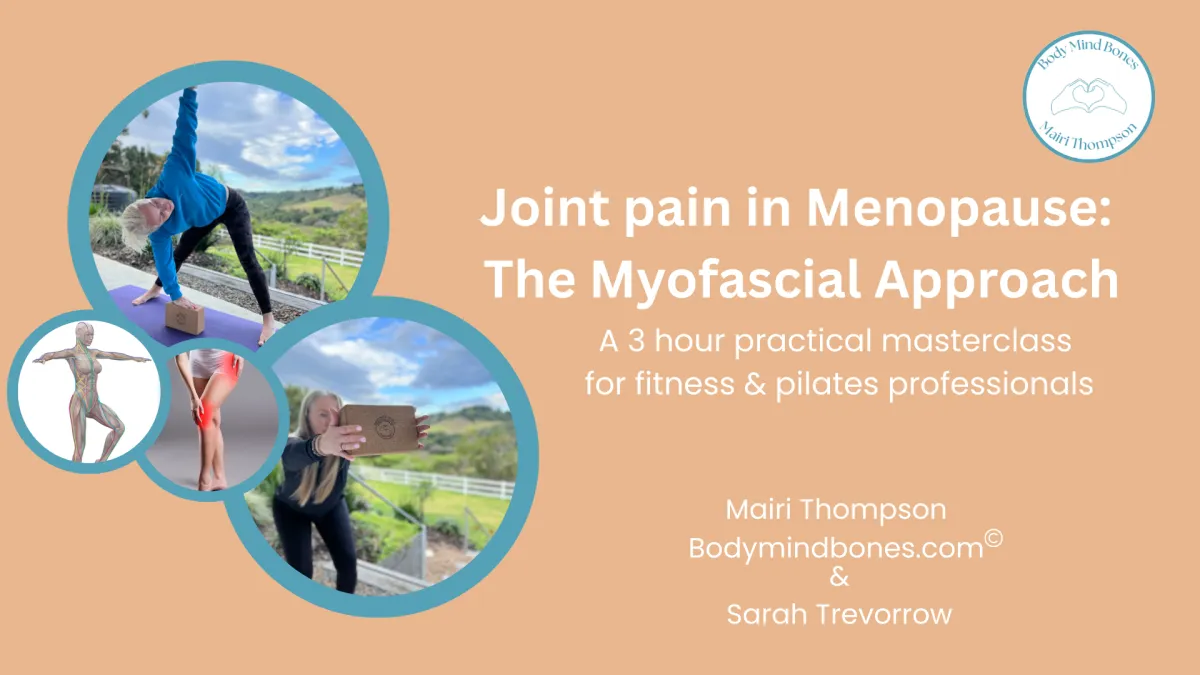
Joint Pain in Menopause: Why Hip Pain Is Just the Beginning
Hip pain is often where it starts.
A client mentions discomfort in their hip during a session. You modify a few exercises, perhaps add some stretches, and hope it settles.
But over time, something else appears.
The knee starts to ache.
The feet feel different.
The shoulders become stiff.
And suddenly, it’s not just hip pain anymore - it’s a broader pattern of joint discomfort that feels unpredictable and harder to manage.
This is something I see time and time again, particularly in women navigating perimenopause and menopause.
Why Joint Pain Increases During Menopause
Joint pain during menopause isn’t random.
Hormonal changes, particularly the decline in oestrogen, impact multiple systems in the body, including:
Tendon health and elasticity
Muscle mass and strength
Fascia (connective tissue) hydration and resilience
The body’s ability to tolerate and recover from load
At the same time, factors like stress, inflammation, and changes in recovery capacity all play a role.
This means that approaches which may have worked previously - stretching more, modifying exercises, or avoiding certain movements - are often no longer enough.
Why This Matters for Fitness & Pilates Professionals
Women aged 40+ are now the fastest growing demographic in the fitness industry.
They are no longer a niche group - they are the foundation of many gyms, studios and classes.
Yet without a clear understanding of menopause-related joint pain, many professionals find themselves:
Modifying exercises without a clear plan
Avoiding loading joints altogether
Under-programming strength, mobility and recovery
Losing clients who no longer feel confident in their bodies
Joint pain has become one of the most common reasons women reduce training, stop attending classes, or disengage completely.
And this is where a more structured approach is needed.
Moving Beyond Guesswork: A Myofascial Approach
To effectively support women in menopause, we need to move beyond reactive programming and towards a more integrated understanding of the body.
This includes:
Recognising patterns of joint pain across the body
Understanding the role of fascia in load distribution and movement
Building strength and resilience progressively
Incorporating recovery and restorative practices
Addressing factors such as stress and inflammation
This is the foundation of a myofascial approach — one that works with the body, rather than against it.
Introducing the Glasgow Masterclass
To bring this into a practical, real-world setting, we’re delivering:
Joint Pain in Menopause: The Myofascial Approach
📍 Glasgow, Scotland
📅 Thursday April 9
⏰ 1PM–4PM
📍 Sarah Peffer Fitness
This is an in-person masterclass designed for:
Personal Trainers
Pilates Instructors
Group Fitness Coaches
Studio & Gym Owners
Exercise Physiologists
What You’ll Learn
This workshop is designed to be practical, structured and immediately applicable.
You’ll gain:
A clear understanding of why joint pain increases during menopause
A simple, repeatable framework to assess hip, knee and foot pain (without being clinical)
Myofascial release techniques you can integrate into sessions and classes
Strategies to create restorative and recovery-based classes
Insight into the gut–inflammation connection and supportive nutrition approaches
Stress management tools, including breathwork for recovery
Take-home menopause “must-have” supplement guidance
Why This Masterclass Matters
This is not about becoming clinical or overcomplicating your sessions.
It’s about giving you:
Clarity
Structure
Confidence
So that you can better support the women who rely on you, and help them continue training with strength and trust in their bodies.
Event Details
Price: £99 (approx $188 AUD)
Spots: Limited
Delivered by:
Mairi Thompson – Menopause Exercise Specialist, BSc Sport & Exercise Science, 20+ years clinical therapy & Pilates experience, Australian Olympic Medical Team Representative
Co-hosted by:
Sarah Trevorrow – Menopause Master Trainer, MRes Exercise Science, Pilates Instructor & PT
Secure Your Place
If you work with women in midlife — or want to better understand joint pain in menopause — this is something you can’t afford to overlook.
👉 Book your spot here!
Hip pain is rarely just about the hip.
And menopause changes the way the body responds to load, stress and movement.
With the right framework, it doesn’t have to feel unpredictable - for you or your clients.